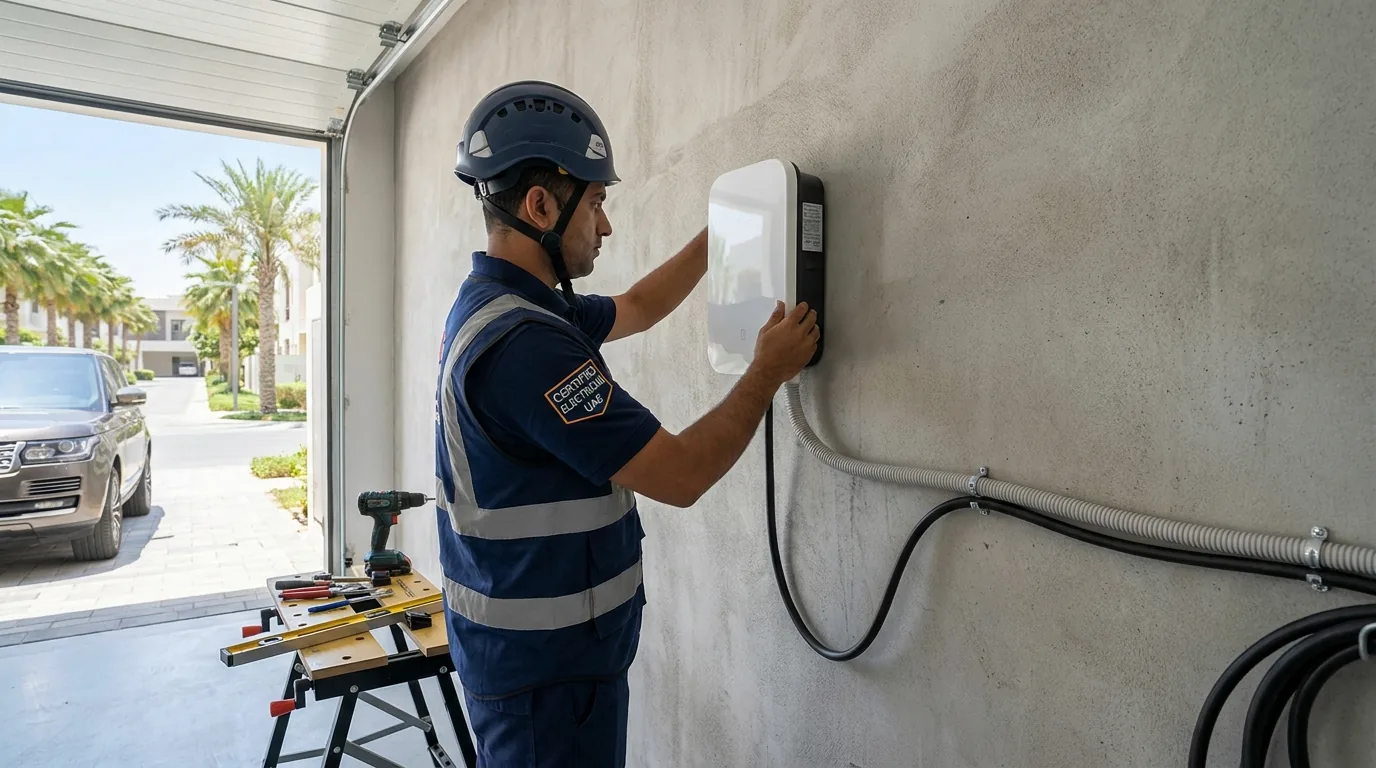
EV charger installation Dubai that meets DEWA and developer rules
EV charger installation Dubai costs AED 8,500–22,000 depending on load and location. Full permits and DEWA inspection included. Typical timeline 8–12 weeks.
- DEWA single-phase 7 kW unit from AED 8,500; three-phase 22 kW from AED 15,000
- Nakheel, Emaar, DAMAC and Sobha NOC required before DEWA application
- Dubai Municipality electrical permit plus civil drawings stamped by licensed consultant
- Dedicated 6–10 mm² cable run from DB to parking; conduit in slab or trench
- Smart charger with OCPP and RFID; 3-year parts and labour warranty included
- Typical cost
- AED 9K – AED 22K
- Timeline
- 8–12 weeks
- Approvals
- Nakheel NOC · Dubai Municipality permit · DEWA inspection · Emaar architectural NOC · DAMAC technical approval
First Unicorn Interiors has completed more than 800 renovation projects across the UAE, including full electrical upgrades that integrate EV charging infrastructure. Our in-house MEP team handles load calculations, cable routing and coordination with DEWA from the initial site survey through final inspection. Every villa or apartment project begins with a review of the existing main distribution board capacity and the developer’s architectural guidelines. In Palm Jumeirah and Emirates Hills communities we frequently encounter 3-phase 22 kW chargers that require a dedicated 10 mm² XLPE cable run of 25–40 metres. The same projects also demand Nakheel or Emaar NOC before DEWA will issue a connection approval. Our three-year warranty covers both the charger hardware and the concealed cable installation, giving owners confidence that future defects will be addressed without additional cost. All pricing is quoted in AED only and we never request advance payments beyond the signed contract stage.
Dubai’s extreme summer temperatures directly affect charger performance and cable derating. Ambient temperatures above 45 °C require XLPE insulated cables with a higher temperature rating than standard PVC. First Unicorn Interiors specifies 90 °C rated XLPE for all outdoor runs and installs chargers inside ventilated wall boxes with IP65 rating. In Jumeirah Golf Estates and Arabian Ranches, where parking is often open, we add a 50 mm PVC conduit buried 600 mm below grade to protect the cable from UV and accidental excavation. The conduit also allows future cable replacement without breaking tiles. We coordinate with the master developer’s landscape team to ensure irrigation lines are not disturbed during trenching. Every trench is backfilled with clean sand and warning tape before reinstatement of interlock or grass. These climate-specific details are documented in the as-built drawings submitted to Dubai Municipality.
The permit process for EV charger installation Dubai follows a strict sequence of approvals. First we obtain the developer NOC confirming the parking location and façade penetration points. For Nakheel communities this involves an online portal submission with single-line diagrams and load schedules. Emaar projects require an architectural NOC plus confirmation that the building’s total connected load remains within the original design envelope. DAMAC and Meraas have additional requirements for smart metering integration. Once developer approval is secured, we submit the complete file to Dubai Municipality for a civil and electrical permit. The final step is DEWA’s application through their e-services portal, which includes the stamped drawings and a signed load-declaration form. DEWA typically issues an inspection date within 10–14 working days. Our project managers track every stage in a shared client portal so owners always know the current status.
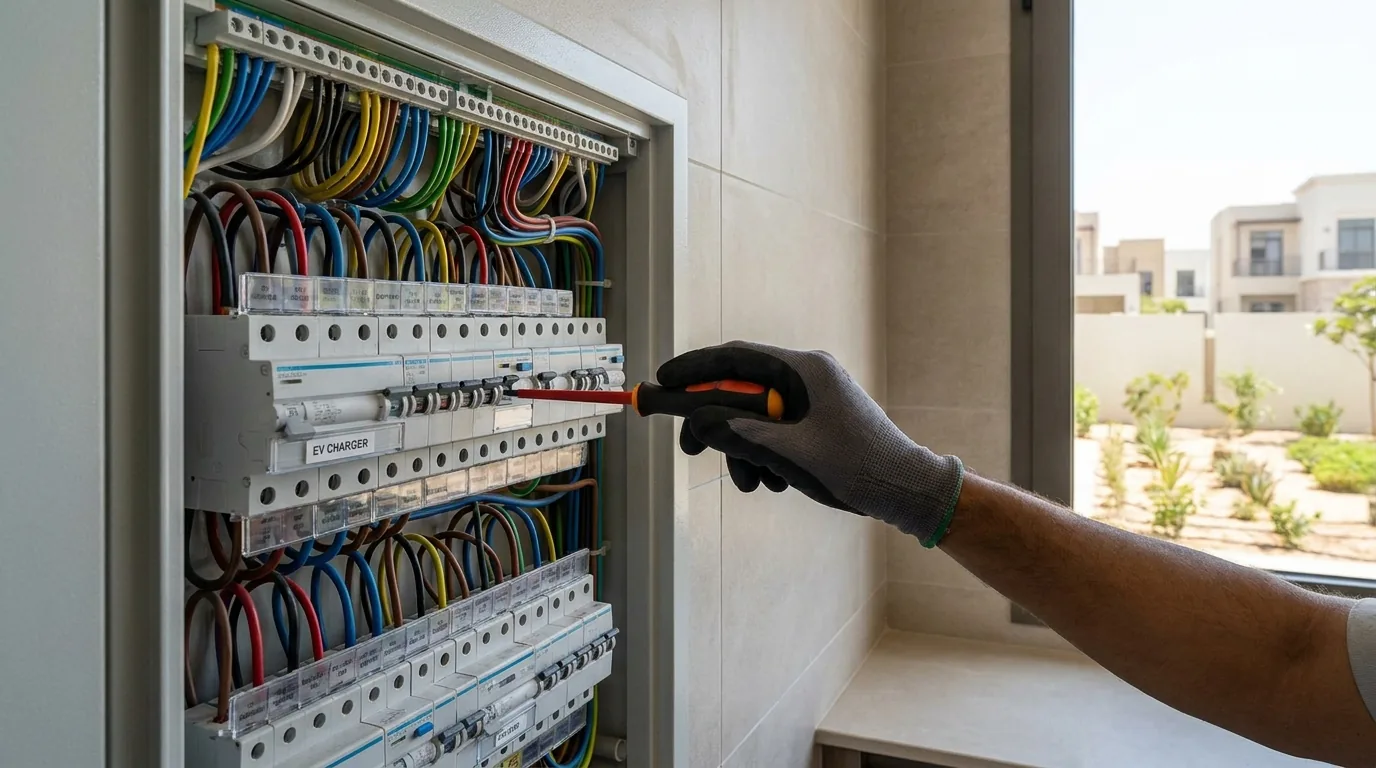
Cable routing decisions depend on whether the property is a villa, townhouse or high-rise apartment. In Emirates Hills and Golf Greens villas we usually surface-mount 50 mm PVC trunking along boundary walls to avoid disturbing expensive landscaping. For apartments in JBR and Dubai Marina the cable must travel through shared risers; we coordinate with building management to obtain riser access permits and fire-stopping details. In all cases the cable size is calculated according to DEWA’s voltage-drop tables, ensuring less than 3 % drop at full 22 kW load. We also install a dedicated 40 A RCBO at the main distribution board for personnel protection. Smart chargers are configured with dynamic load management so the vehicle cannot exceed the available supply when other high-draw appliances are running. This prevents nuisance tripping during peak summer air-conditioning loads.
Material selection focuses on durability in Dubai’s saline coastal environment. Chargers from reputable European and Japanese brands are chosen for their corrosion-resistant enclosures and five-year manufacturer warranties. We use marine-grade stainless-steel fixings and UV-stabilised conduit for all external work. Cable joints are made with heat-shrink kits rated for direct burial. In projects where the charger is mounted on a rendered boundary wall we apply an anti-carbonation coating to the wall before installation to prevent future cracking around fixings. All consumables are sourced from DEWA-approved suppliers, ensuring compatibility during the final inspection. Our procurement team maintains stock of the most common cable sizes and trunking so projects are not delayed by material lead times.
Contractor selection criteria for EV charger installation Dubai should include DEWA-approved electrical contractor status, in-house design capability and documented experience with the specific master developer. First Unicorn Interiors maintains current approvals with Nakheel, Emaar, DAMAC, Sobha and Meraas. Our design team produces single-line diagrams and load schedules that pass first-submission review in more than 90 % of cases. We also carry professional indemnity insurance that covers any consequential damage arising from electrical works. Clients receive a detailed method statement before work begins, outlining traffic management, dust control and working hours in line with Dubai Municipality noise regulations. This level of documentation reduces the risk of project stoppage due to neighbour complaints or inspector queries.
Cost benchmarks for EV charger installation Dubai vary according to charger capacity, cable length and whether civil works are required. A single-phase 7 kW wallbox with 15 m cable run and minimal trenching starts at AED 8,500. Upgrading to a three-phase 22 kW unit with 30 m cable, 50 mm conduit and full Nakheel NOC coordination brings the price to AED 15,000–18,000. Projects requiring new DB breakers, additional civil drawings or façade coring in Emirates Hills villas can reach AED 22,000. These figures include all permits, DEWA inspection fees, charger hardware and three-year warranty registration. No hidden charges appear after contract signing. Clients receive a fixed-price quotation valid for 30 days, allowing time to obtain internal family approvals.
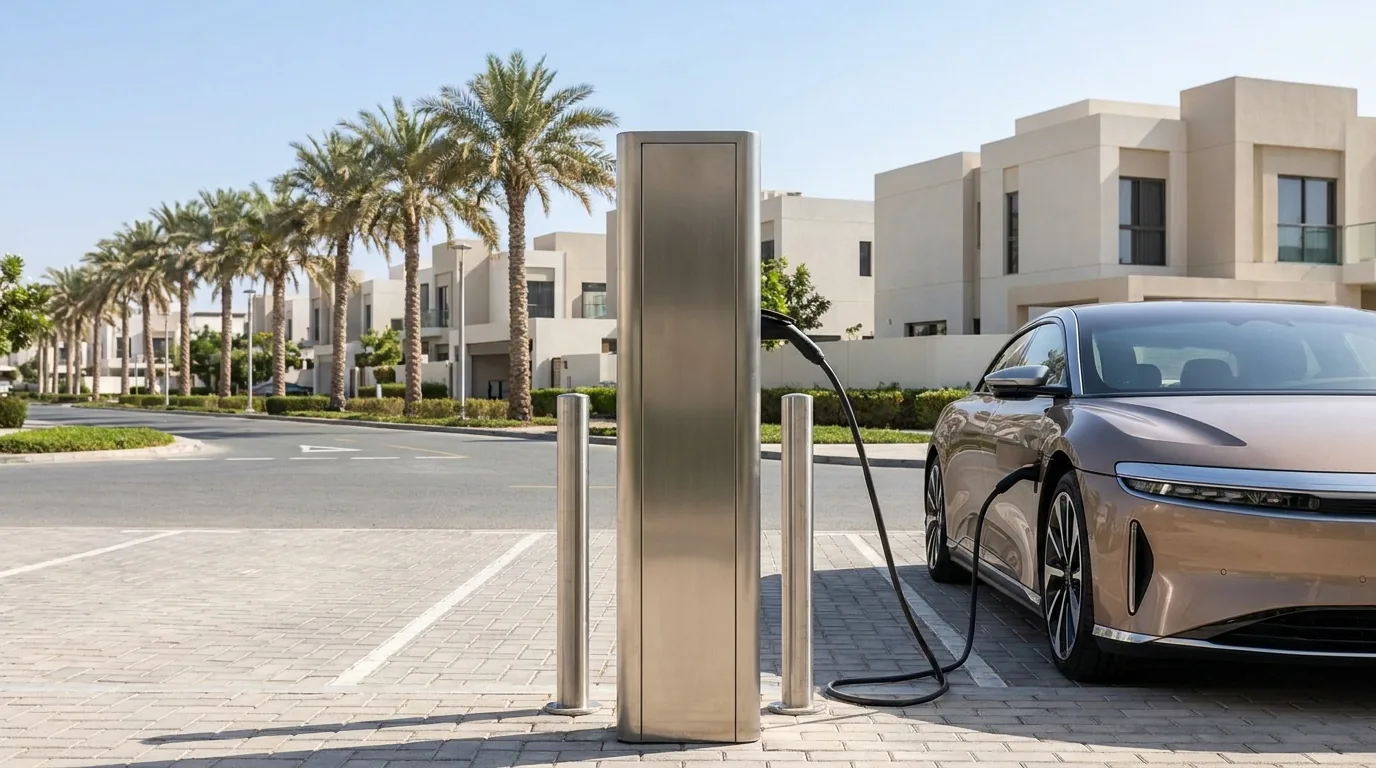
Timeline management begins with the site survey, which we complete within 48 hours of receiving villa or apartment access. The survey report includes photos of the existing DB, proposed cable route and any obstacles such as swimming pools or mature landscaping. Within five working days we submit the developer NOC package. Nakheel and Emaar typically respond in 7–10 days; DAMAC may require 14 days for technical review. Once NOCs are in hand, Dubai Municipality permit processing takes another 5–7 days. DEWA inspection is booked immediately after permit issuance. Physical installation itself takes two to three days: one day for cable pulling and trunking, one day for charger mounting and testing, and a final half-day for DEWA witness testing. The entire process from survey to energisation averages 8–12 weeks when no major DB upgrade is required.
Quality control checkpoints are embedded at every stage. After cable installation we perform a 500 V megger test on the new circuit and record insulation resistance values above 1 MΩ. Polarity and earth-loop impedance are verified before the charger is powered. The smart charger is then paired with the client’s Wi-Fi and configured for scheduled charging during off-peak DEWA tariff hours. We also set the maximum current limit to match the RCBO rating and provide the client with a laminated single-line diagram for future reference. All test results are uploaded to the project folder and shared with the client. This documentation satisfies RERA requirements for service-contract transparency and supports any future property sale due diligence.
Post-installation support includes remote monitoring of charger status through the manufacturer’s cloud platform. First Unicorn Interiors receives automated alerts for any fault codes and can dispatch a technician within 24 hours. The three-year warranty covers both parts and labour for charger replacement, cable faults and any water ingress issues. Clients also receive an annual service visit that includes cleaning of ventilation slots, verification of earth continuity and firmware update if available. This proactive approach prevents small issues from becoming warranty claims. All service records are stored against the property’s DEWA account number for easy transfer to new owners.
Regulatory changes in 2024 require all new EV chargers in Dubai to support ISO 15118 plug-and-charge functionality. First Unicorn Interiors has updated its standard specification to include this feature at no extra cost. We also register every installation with DEWA’s EV charging database, which is used for future grid-planning studies. This registration is mandatory for obtaining the final completion certificate. Our design templates already incorporate the new requirements, ensuring projects started today will remain compliant without future modification. Clients benefit from future-proofing without additional expense.
Community-specific rules add another layer of complexity. In Dubai Hills Estate the developer requires chargers to be recessed into boundary walls with a minimum 150 mm setback from the pavement. Emirates Living mandates that cable trunking colour matches the villa façade. Arabian Ranches 2 requires a separate civil NOC from the community consultant before DEWA submission. First Unicorn Interiors maintains a living database of these micro-rules and updates it after every project. This institutional knowledge reduces approval times and prevents costly reworks. Clients receive a community-specific checklist at contract stage so expectations are aligned from day one.
Definitions
- DEWA NOC
- Dubai Electricity and Water Authority approval confirming the building’s electrical infrastructure can support the added EV load without upgrade.
- Developer NOC
- Written consent from master developer (Emaar, Nakheel, DAMAC) confirming charger location, cable routing and façade penetrations comply with community rules.
- MDB
- Main Distribution Board; the primary electrical panel where the new EV circuit originates and where load calculations are verified.
- OCPP
- Open Charge Point Protocol allowing remote monitoring, billing integration and firmware updates on smart chargers.
- RERA
- Real Estate Regulatory Agency; governs service contracts and warranty registration for renovation works in Dubai freehold properties.
- Civil NOC
- Dubai Municipality stamped drawings for any trenching, coring or façade works required to route cables to parking spaces.
How we run an EV charger installation project
- Site survey & load audit. Our MEP engineer measures existing DB capacity, records cable routes and photographs parking location. Load calculations are prepared according to DEWA guidelines and developer rules.
- Developer NOC submission. Single-line diagrams, load schedules and site photos are uploaded to the relevant portal. Nakheel, Emaar or DAMAC review and issue stamped approval, typically within 7–14 days.
- Dubai Municipality permit. Civil and electrical drawings are submitted with the developer NOC. Permit issuance takes 5–7 days and includes payment of inspection fees.
- DEWA application & inspection booking. Final file is submitted through DEWA e-services. Inspection date is confirmed within 10–14 working days after permit issuance.
- Cable installation & trunking. Dedicated circuit is pulled from DB to parking using approved XLPE cable in conduit or trunking. Megger and earth tests are performed same day.
- Charger mounting & commissioning. Unit is fixed, wired and paired with Wi-Fi. Dynamic load management is configured and client receives login credentials for the monitoring app.
- DEWA witness test & handover. DEWA inspector verifies installation against approved drawings. Completion certificate is issued and three-year warranty is registered with RERA.
- Annual service & remote support. First Unicorn provides yearly maintenance visit plus 24-hour remote monitoring and fault response for the full warranty period.
Planning a ev charger installation? Fixed-price quote in 24 hours
Free site visit for projects over AED 10,000. 3-year warranty on all works.
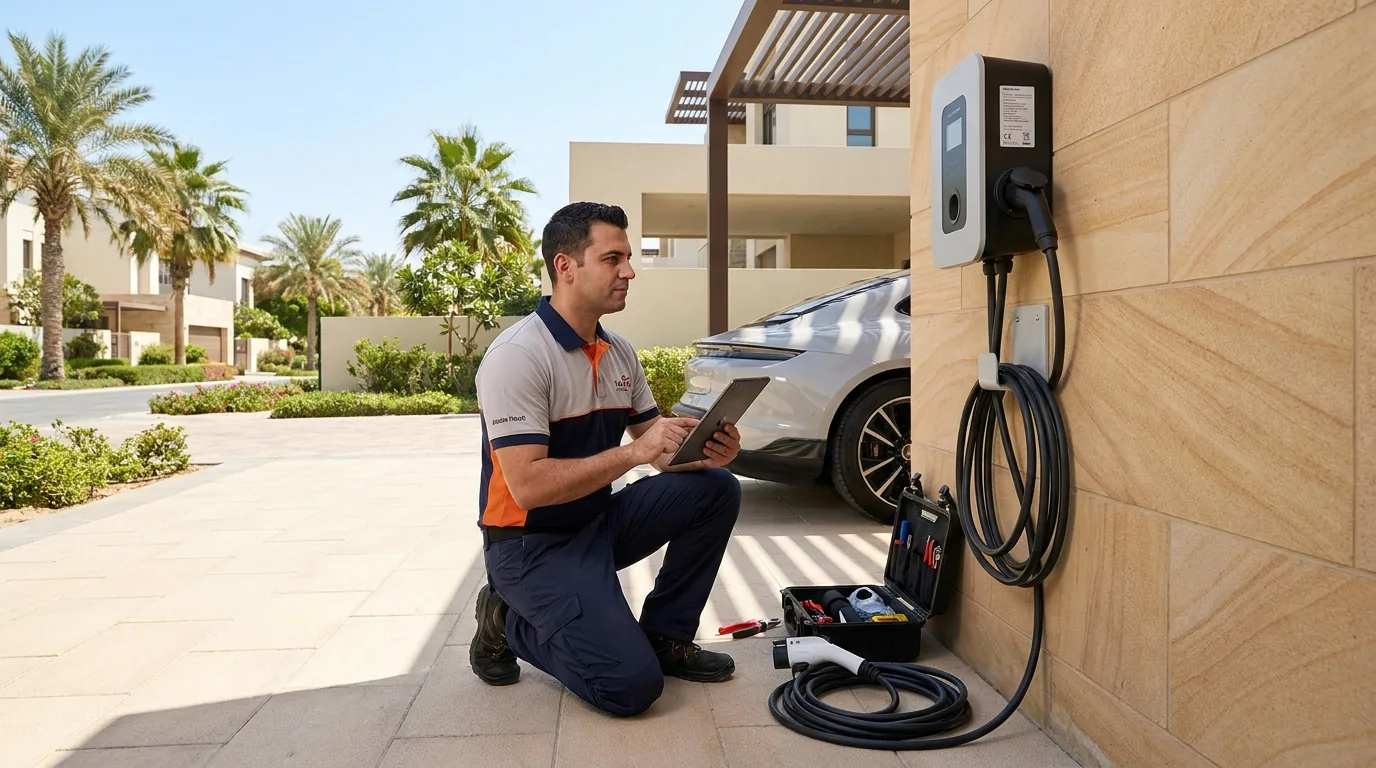
Tier comparison
| Tier | Scope / spec | Typical AED |
|---|---|---|
| Budget | 7 kW single-phase charger, 15 m cable, basic wallbox, no smart features | AED 8,500–10,500 |
| Mid-range | 22 kW three-phase charger, 25 m cable, OCPP app control, DEWA metering | AED 14,000–16,500 |
| Premium | 22 kW charger, 35 m cable, dynamic load management, façade integration, full NOCs | AED 17,500–19,500 |
| Ultra-luxury | Dual 22 kW units, 50 m+ cable, underground conduit, BMS integration, gold-plated finishes | AED 22,000+ |
Frequently asked questions
How long does EV charger installation Dubai take?
Do I need Nakheel or Emaar approval?
What is the minimum cable size for 22 kW?
Is a smart charger mandatory?
Can I install in an apartment parking space?
What warranty is included?
Free quote — same-day reply
WhatsApp the team on +971 58 565 8002. 800+ projects delivered. 3-year craftsmanship warranty.
WhatsApp +971 58 565 8002Sources & references
Recent work across the UAE.
A glimpse of current First Unicorn projects — interiors, kitchens, bathrooms, pools and glasswork.