
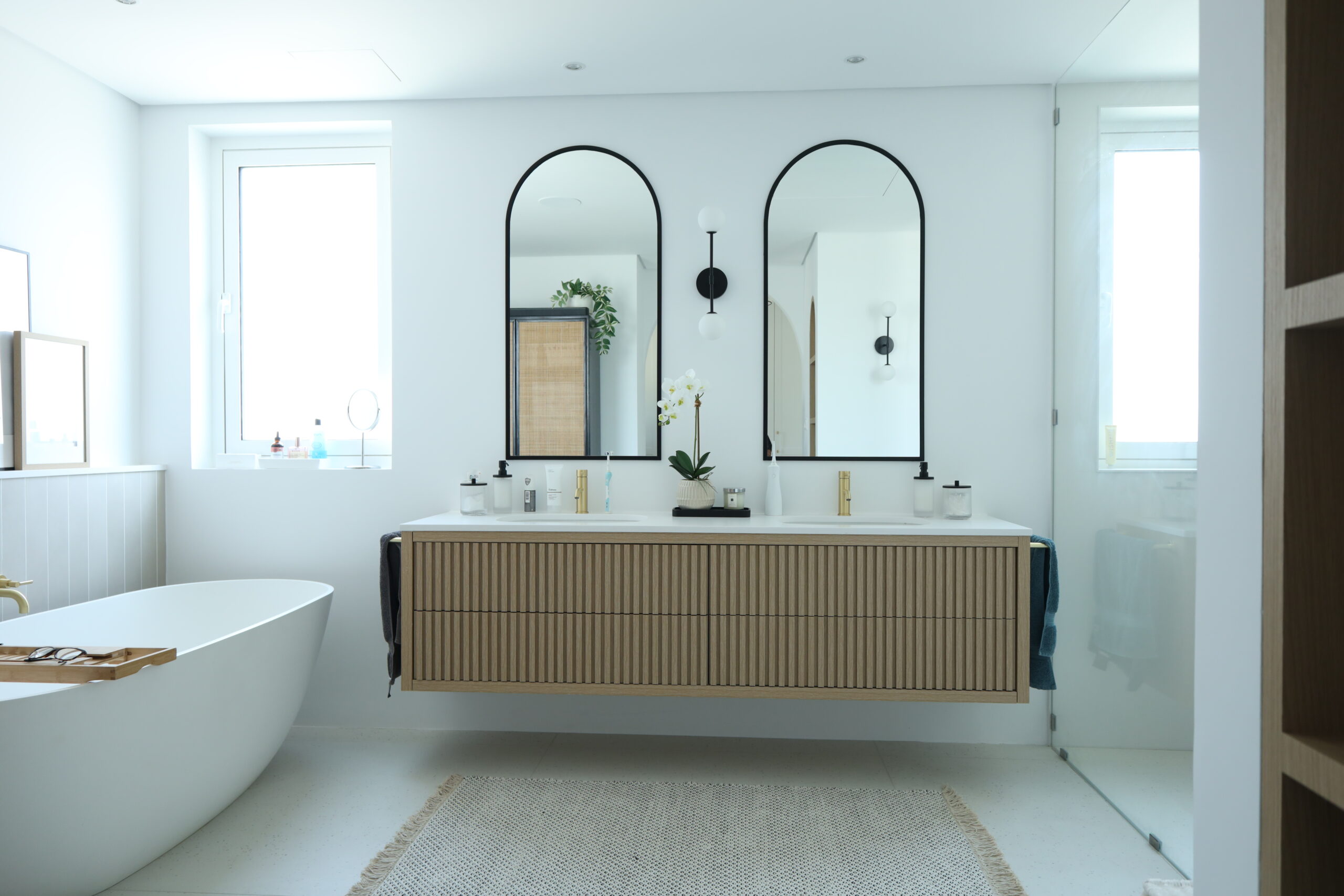
Home renovation in Dubai for a full villa typically costs AED 250,000-1,500,000 and takes 6-24 weeks, depending on finish level and scope. A partial refresh runs AED 250,000-450,000; full-standard AED 450,000-800,000; luxury AED 800,000-1,500,000. Developer NOC and Dubai Municipality approval come first; pricing is confirmed only after on-site survey.
- Palm Jumeirah villas need Trakhees approval (15-25 working days); Emirates Hills and Dubai Hills need an Emaar NOC.
- Full villa renovation: AED 250,000-1,500,000 over 6-24 weeks. Indicative only, confirmed after on-site survey.
- Dubai Municipality fit-out plan approval: 10-15 working days; Civil Defence fire and life safety: 5-10 working days.
- DEWA connection or modification approval takes 7-14 working days and runs partly in parallel with other permits.
- DAMAC Hills 1 routes via DDA and Damac Hills 2 via Dubai Municipality; apply through the DAMAC Living app (5-15 days).
- Typical cost
- AED 250K – AED 1.5M
- Timeline
- 6-24 weeks
- Approvals
- Master developer NOC (Emaar / Nakheel / DAMAC) · Dubai Municipality building / fit-out plan approval · Dubai Civil Defence fire and life safety approval · DEWA connection or modification approval · Trakhees permit (Palm Jumeirah, Jebel Ali) · DAMAC community management NOC via DAMAC Living app · DDA approval (Damac Hills 1)
Home renovation in Dubai, for most of the homeowners we work with, means a full villa renovation: civils, MEP, finishes and, where the scope includes it, landscaping. Indicatively, a villa renovation costs AED 250,000-1,500,000 over a timeline of 6-24 weeks. Where your project falls inside that band depends on finish level, materials sourcing, structural complexity and the developer approval cycle. These are indicative ranges, confirmed only after an on-site survey. They are never a quoted price before we have measured the property and checked what sits behind the walls. First Unicorn Interiors has delivered 800+ projects across the emirate with an in-house team. That matters because the largest overruns on Dubai renovations usually come from coordination gaps between subcontractors rather than from materials. Every completed project carries a 3-year warranty, and every figure on this page is in AED. The sections below cover the tiers, the permits, the community rules and the technical decisions that shape what a villa renovation actually costs.
We price villa work in three tiers so you can match budget to ambition early. A partial refresh costs AED 250,000-450,000 and typically runs 6-10 weeks. It covers paint, flooring, a joinery refresh and light finishes: the right choice when the layout works but the villa looks dated. A full-standard renovation costs AED 450,000-800,000 and runs 12-18 weeks. It adds civils and MEP to a complete set of new finishes, so walls can move, bathrooms and kitchens are rebuilt from the slab, and services are replaced rather than patched. A luxury renovation costs AED 800,000-1,500,000 over 18-24 weeks. It adds bespoke joinery, imported stone and smart home systems. Tiers overlap at their edges on purpose. A refresh with heavy joinery can approach the full-standard band, and a full-standard project with imported stone can cross into luxury. The survey shows which tier your brief really sits in.
Three factors move a quote within its tier, and knowing them helps you control the budget. The first is size. A three-bedroom villa sits below our four-bedroom baseline, while five-, six- and seven-plus-bedroom homes scale up progressively because there are more wet areas, longer MEP runs and more square metres of finish. The second is finish level. An essential specification reduces cost meaningfully compared with our premium baseline, a luxury specification adds substantially, and an ultra specification with rare stone, couture hardware and fully integrated automation can roughly double the finishes budget. The third is the community. Prime communities carry higher costs than mid-market ones because developer guidelines are stricter, site access and working hours are more restricted, and expectations around detailing are higher. We explain these effects in plain terms during consultation rather than turning them into headline numbers, because the combination is specific to each villa.
Approvals are where Dubai renovations most often lose time. Most villa projects need a Dubai Municipality building or fit-out plan approval, which typically takes 10-15 working days. Any change to fire alarms, sprinklers, escape routes or kitchen extraction needs Dubai Civil Defence approval for fire and life safety, typically 5-10 working days. Moving the main distribution board, increasing electrical load or adding a new connection needs DEWA approval for connection or modification, which takes 7-14 working days. Before any of these, most gated communities require a master developer NOC, which takes 10-20 working days depending on the community. Several of these run partly in parallel, so they should never simply be added together into one total. A well-prepared drawing set, submitted once and correctly, is the biggest single factor in how fast your permits clear. Our in-house team prepares and tracks every submission so construction starts as soon as approval is granted.
Each master developer runs its own NOC process and design guidelines. Emaar governs Arabian Ranches, Dubai Hills Estate, Emirates Hills and The Meadows, and its community teams check external changes such as facades, pergolas, boundary walls and pool additions against the original masterplan. Nakheel manages Jumeirah Islands, Jumeirah Park and Al Furjan, and also controls developer consent on Palm Jumeirah. Meraas and Sobha apply their own requirements in communities such as City Walk and Sobha Hartland. Palm Jumeirah, Jebel Ali and other designated jurisdictions fall under Trakhees, whose approval typically takes 15-25 working days and replaces Dubai Municipality as the permitting authority there. To build a timeline that holds, you need to know which authority and which developer have jurisdiction before drawings are finalised. Submitting to the wrong body, or under the wrong community guideline, is one of the most common reasons we see projects stall when owners come to us mid-way.
DAMAC communities, including DAMAC Hills 1 and 2, Akoya, the Lagoons and DAMAC Islands, have a distinct process. The DAMAC community management NOC typically takes 5-15 days, and applications are made through the DAMAC Living app. Routing differs by community. DAMAC Hills 1 projects are approved by the Dubai Development Authority (DDA), while DAMAC Hills 2 projects go to Dubai Municipality. Damac Hills 2 also requires a separate landscape NOC, so garden, pool deck and boundary work cannot ride on the interior approval. Major extensions pay a GFA fee to DAMAC Properties before the final NOC is issued. Structural additions over 50% of BUA also need an Al Sa'fat 2.0 sustainability statement. DAMAC charges an admin fee and takes a security deposit. The deposit is refundable against common-area damage and against overruns past the approved period, so an accurate programme protects your money as well as your schedule.
Dubai's climate shapes every specification decision we make. Long summers of intense heat and high humidity punish poorly detailed waterproofing, under-insulated roofs and ductwork that sweats into ceiling voids. In coastal communities like Palm Jumeirah, Jumeirah Islands and the Lagoons, salt-laden air corrodes standard steel fixings, outdoor lighting and AC condenser coils, so we specify marine-grade hardware and coated components there. Fine sand works its way into window tracks, sliding door gaskets and AC return grilles, so we prioritise sealed glazing systems and accessible filtration. Externally, UV exposure fades and chalks lower-grade paints and timbers, which is why we favour UV-stable render finishes, porcelain or stone for terraces, and composite decking over untreated wood. Internally, high-performance glazing and roof insulation upgrades reduce cooling load. That keeps rooms comfortable and lowers DEWA bills for years after handover. None of this is visible in a render, but it decides how a renovation performs in its third summer.
MEP is where a renovation either lasts or quietly fails. Many older Dubai villas still run original split or ducted AC systems, undersized distribution boards and pipework that has reached the end of its life. In a full-standard or luxury scope we replace rather than patch. We run new power circuits sized for modern kitchens, EV chargers and smart systems, replace water supply lines, re-grade drainage, and rebalance or replace the air conditioning so each zone actually reaches its set point. Any increase in electrical load, or any relocation of the main board, goes through DEWA approval. Changes to detectors, alarm panels or extraction go through Civil Defence. We complete load calculations before the design is frozen so the permit drawings match what is built, and our in-house MEP engineers test and commission every system before handover. Your 3-year warranty covers this hidden infrastructure as well as the finishes, which is where most other warranties stop short.
Material choices drive both budget and programme. Imported marble, onyx and natural stone from Italy, Spain or Turkey can look extraordinary, but they bring longer lead times and require slab selection, so in the luxury tier we lock stone early to protect the 18-24 week timeline. Large-format porcelain is a strong alternative for most floors: harder wearing, consistent in colour and readily available in Dubai. For joinery, moisture-resistant board with high-quality veneers or lacquers suits most kitchens and wardrobes, while solid timber and bespoke metalwork belong in the luxury specification. Quartz and sintered stone countertops resist heat and staining better than many natural stones in a busy family kitchen. Sanitaryware and brassware should come from brands with local service support, because a discontinued cartridge can leave a bathroom out of use. We present each option with its effect on cost and timeline so the trade-offs are clear before anything is ordered.
Recent completed project: [EDITOR: replace this paragraph with verified details from First Unicorn Interiors project records before publishing, including community, villa type, bedroom count, tier delivered, scope and actual programme. Use only canonical AED ranges, or no AED figures at all.] Describe the before/after transformation in specific, verifiable terms. Before: the layout, condition and problems the owner faced, such as a closed kitchen, dated bathrooms, failing AC, poor natural light or water ingress. After: what changed structurally, which MEP systems were replaced, which finishes and joinery were installed, and how the villa now works for the family. Name the approvals obtained, such as the master developer NOC, the Dubai Municipality or Trakhees permit and the DEWA approval, and say how long each took against the canonical windows. Note any surprises found during demolition and how the in-house team resolved them without derailing the programme. Close with the handover, snagging outcome and the 3-year warranty activation.
Choosing a contractor is the most important decision in any villa renovation. Start with licensing. The company should hold a valid Dubai trade licence covering fit-out or contracting activities, and be able to submit permit drawings to Dubai Municipality, Trakhees or the DDA in its own name. Ask for contractor's all-risk and third-party liability insurance, because developers will not issue an NOC without it. Check whether trades are in-house or subcontracted: an in-house team gives one point of accountability for programme, quality and snagging. Insist on a written scope with drawings and a finishes schedule, and payment milestones tied to completed stages rather than dates. Confirm what the warranty covers and for how long, and ask to see completed villas in your own community, since each developer's rules differ. Finally, judge how clearly the contractor explains approvals, because that conversation shows whether they have actually done it before. "[EDITOR: insert a verbatim quote from a real, consenting First Unicorn client]" — [Firstname L.]
Ownership documentation and community governance also matter. A master developer NOC application normally needs the title deed issued by the Dubai Land Department (DLD), the owner's identification, the contractor's trade licence and insurance, and a drawing set showing the proposed works. If the villa is tenanted, the landlord and tenant obligations set out under RERA rules should be agreed before work starts, including who bears disruption and when the property will be handed back. Owners outside the UAE can authorise us to manage submissions on their behalf, with progress shared by photo and video at each stage. At handover we complete a full snagging walk-through, provide as-built documentation and operating guides for MEP systems, and register the 3-year warranty. If you are planning a home renovation in Dubai and want a survey-based estimate, message our team on WhatsApp at +971 58 565 8002. We will confirm which tier fits your brief and which approvals your community requires.
Definitions
- NOC (No Objection Certificate)
- Written consent from the master developer or community management, such as Emaar, Nakheel or DAMAC, that is required before renovation works can start inside a gated community.
- Master developer
- The company that built and manages a community and controls its design guidelines, e.g. Emaar for Arabian Ranches and Dubai Hills Estate, or Nakheel for Jumeirah Islands.
- Trakhees
- The building and planning regulator for Palm Jumeirah, Jebel Ali and other designated jurisdictions. Within those areas it issues permits in place of Dubai Municipality.
- MEP
- Mechanical, electrical and plumbing: air conditioning, ventilation, wiring, distribution boards, water supply and drainage. MEP changes usually trigger DEWA and Civil Defence review.
- BUA (Built-Up Area)
- The total constructed floor area of a villa. In DAMAC communities, structural additions over 50% of BUA require an Al Sa'fat 2.0 sustainability statement.
- Al Sa'fat
- Dubai's green building rating system. It sets sustainability requirements for new construction and for major additions to existing buildings.
How we run a villa renovation project
- Consultation and on-site survey. We visit the villa, measure every room and inspect MEP, waterproofing and structure. We also confirm which master developer and permitting authority have jurisdiction, because that sets the approval route.
- Design and specification. Our designers develop layouts, 3D visuals and a finishes schedule matched to your chosen tier. Long-lead items such as imported stone are flagged so they can be ordered early.
- Indicative to confirmed cost. We convert the canonical tier range into a confirmed, itemised cost based on the survey and the final specification. Payment milestones are tied to completed stages of work.
- NOC and permit submissions. We prepare and submit drawings for the master developer NOC, Dubai Municipality or Trakhees approval, Civil Defence and DEWA as required. Parallel submissions are tracked so no authority holds up the others.
- Demolition, civils and MEP. Our in-house team carries out strip-out, structural changes, waterproofing and full MEP works. We record hidden conditions found during demolition before any walls are closed up.
- Finishes and joinery. Flooring, stone, joinery, sanitaryware and lighting are installed to the agreed specification. Quality checks at each trade handover prevent defects from being buried under the next layer.
- Testing, snagging and handover. Every MEP system is tested and commissioned, and we complete a joint snagging walk-through with you. You receive as-built documents and your 3-year warranty at handover.
Tier comparison
| Tier | Scope / spec | Typical AED |
|---|---|---|
| Budget | Partial refresh: paint, flooring, joinery refresh and light finishes, with the existing layout and services retained; typically 6-10 weeks. | AED 250,000-450,000 |
| Mid-range | Full-standard: civils, complete MEP replacement and full new finishes throughout; typically 12-18 weeks. | AED 450,000-800,000 |
| Premium | Luxury: bespoke joinery, imported stone and integrated smart home systems; typically 18-24 weeks. | AED 800,000-1,500,000 |
| Ultra-luxury | Rare stone, couture hardware and fully integrated automation on large villas in prime communities. Costs rise substantially with finish level and size and are confirmed only after an on-site survey. | Priced after on-site survey |
See exactly where every dirham goes — no hidden costs, no scope creep.
Get my free quote on WhatsApp →
Frequently asked questions
How much does home renovation in Dubai cost for a villa?
How long does a villa renovation take in Dubai?
Which approvals do I need to renovate a villa in Dubai?
Is the process different on Palm Jumeirah?
How do renovation approvals work in DAMAC communities?
What warranty do you provide?
- Fixed-price contract — fully itemized, no hidden costs or mid-project surprises.
- 3-year workmanship warranty on every project.
- In-house team — designers, engineers and trades under one roof, no subcontractor markups.
- Approvals handled — we manage Dubai Municipality, DEWA and developer NOCs for you.
- 800+ projects delivered across Dubai.
Free quote — same-day reply
WhatsApp the team on +971 58 565 8002. 800+ projects delivered. Fixed price, 3-year warranty, approvals handled.